Tonopah & Goldfield Railroad
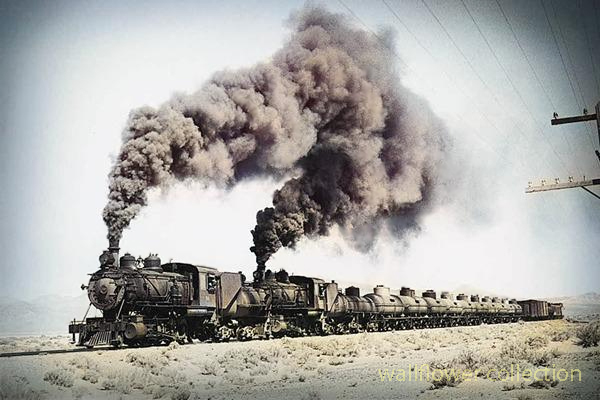
The Tonopah & Goldfield Railroad connected the mining camps of Goldfield and Tonopah with the Southern Pacific connection at Mina. From 1905 to 1947, it carried ore, supplies, passengers, and mail through one of Nevada's great early mining regions.
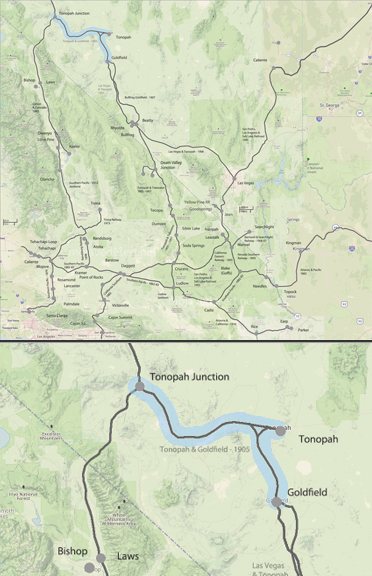
Tonopah & Goldfield Railroad route and connections, circa 1910. The railroad's owned line ran from Goldfield to Tonopah Junction; from there it operated over Southern Pacific trackage rights to Mina.
The Tonopah & Goldfield Railroad, usually called the T&G, was one of the principal mining railroads of central Nevada. It served the silver camp at Tonopah and the gold camp at Goldfield, carrying passengers, freight, machinery, timber, fuel, food, mail, ore, and bullion.
The railroad was the northern outlet for the two mining districts. Its trains ran between Goldfield and Tonopah Junction, where the company connected with the Southern Pacific route toward Mina. Through that connection, Tonopah and Goldfield gained access to Reno, San Francisco, and the national rail system.
The T&G should not be confused with the Carson & Colorado Railroad, even though the two were closely connected. The Carson & Colorado route, then controlled by Southern Pacific and later associated with the Nevada & California Railway, linked Tonopah Junction and Mina. The T&G served Tonopah, Millers, Blair Junction, and Goldfield.
The Tonopah Railroad
The T&G grew out of the Tonopah boom. Rich silver ore was discovered near Tonopah in 1900, but the new camp lay far from a railroad. Freight had to come in by wagon from the Carson & Colorado Railroad, a difficult and expensive arrangement for a rapidly growing mining town.In 1903, survey work began on a railroad from Tonopah Junction to Tonopah. The Tonopah Railroad Company was organized on July 25, 1903. Its narrow-gauge line reached Tonopah on July 23, 1904.
The new railroad immediately changed the town's prospects. It brought in heavy mining machinery, boilers, timbers, fuel, food, mail, and passengers far more efficiently than wagon freight could. It also carried ore and bullion outward. The earliest line was not without trouble: floods damaged portions of it soon after construction.
The Tonopah Railroad was built to a three-foot gauge, but the Southern Pacific route to which it connected was being converted to standard gauge. The Tonopah line was therefore rebuilt to standard gauge in 1905, allowing cars to move more easily between the mining district and the larger railroad system.
The Goldfield extension
Goldfield had been discovered in 1902, and within a few years it was growing even faster than Tonopah. The prospect of a railroad connection drew investors, merchants, mine operators, and promoters to the district.Surveys for a line from Tonopah to Goldfield began in the summer of 1904 under the Goldfield Syndicate. Grading began in February 1905, and railroad service was established later that year. On November 1, 1905, the Tonopah Railroad and Goldfield Railroad were consolidated as the Tonopah & Goldfield Railroad.
The T&G then became the through line for the two camps. Its owned route extended about 88 miles from Goldfield through Tonopah to Tonopah Junction. From Tonopah Junction, the company operated over roughly nine miles of Southern Pacific trackage rights to Mina. In all, the Goldfield-to-Mina operation was about 97 miles.
The main line passed through open desert country, crossing broad valleys and running near the Monte Cristo Range. Millers, west of Tonopah, became an especially important point on the railroad. Blair Junction, farther along the line, became the connection for the Silver Peak mining district.
Millers and the Tonopah mills
Millers began as a station and watering stop, but it soon developed into an important milling and railroad center. The Tonopah Mining Company built a 100-stamp mill and power plant there in 1906. The railroad hauled Tonopah ore to Millers and brought in the machinery, fuel, and supplies needed to operate the mill.For several years, the Millers traffic was an important part of T&G business. Freight bills, delivery receipts, and ore-storage records preserved in mining-company archives show the railroad's practical work: moving ore, materials, and equipment between the mines, mill, and outside world.
The arrangement did not last forever. In 1911 and 1912, the Tonopah Belmont Mining Company built a mill closer to the mines at Tonopah. Ore that previously had been hauled to Millers could then be treated nearer its source. The change reduced a major source of T&G traffic and was an early sign of how mining and transportation patterns were changing.
Blair Junction and the Silver Peak Railroad
The T&G also served as the outlet for the Silver Peak district. In 1906, the Pittsburgh-Silver Peak Gold Mining Company built the standard-gauge Silver Peak Railroad from Blair Junction on the T&G main line to its mines and 100-stamp mill at Blair, near Silver Peak. The branch was about 17½ miles long.Blair Junction became a useful railroad point, with a depot, water facilities, and connections for freight and passengers. Through the T&G, ore, supplies, workers, and mail could move between the Silver Peak country, Tonopah, Goldfield, and the Southern Pacific connection at Mina.
The Silver Peak Railroad depended on the Blair mines and mill. When that operation declined, the branch was dismantled in the late 1910s. Blair Junction continued as a T&G station and shipping point until the main line itself was abandoned in 1947.
Competition at Goldfield
Several competing railroads served Goldfield during the boom years. The T&G approached from the north through Tonopah and Mina. The Bullfrog Goldfield Railroad came north from the Beatty and Rhyolite country. The Las Vegas & Tonopah Railroad reached Goldfield from Las Vegas by way of Beatty and Rhyolite. The Tonopah & Tidewater Railroad came north from Ludlow, California, through the Death Valley region and gained access toward Goldfield through the Bullfrog Goldfield line.Competition was intense because all the railroads wanted the same traffic: passengers, mining machinery, timber, fuel, food, mail, ore, and bullion. Each company expected the mining camps to remain prosperous for years.
The T&G's advantage was its established connection with Southern Pacific at Mina. Its disadvantage was that the same mining production that created the railroad's traffic could decline abruptly. The railroad's fate remained tied to the fortunes of Tonopah, Goldfield, Millers, Blair, and the other camps it served.
Shops and terminals
The T&G maintained important facilities at both Tonopah and Goldfield. After the railroad shops at Tonopah burned in 1909, the T&G built new shops and a terminal at Goldfield in 1910, near Aluminum and Fourth Streets.Goldfield was then a major railroad center, with several companies maintaining depots, yards, tracks, and offices. The T&G remained central to the town because it provided the direct connection north through Tonopah to Mina and Southern Pacific.
Decline and abandonment
The railroad boom depended upon mining production. Goldfield's great output declined after its early peak, and Tonopah's production also declined over time. As mines closed or cut back, railroad freight fell.The competing lines disappeared first. The Las Vegas & Tonopah Railroad ended operations in 1918. The Bullfrog Goldfield Railroad was abandoned in 1928. The Tonopah & Tidewater continued longer, aided by borax and other traffic, but ceased operation in 1940.
The T&G survived because it still served Tonopah, Goldfield, ranches, mining properties, and the remaining freight business. During the 1920s and 1930s, it cut costs by using motor cars for much of its passenger service while steam locomotives continued to handle freight and mixed trains. The railroad entered receivership from 1932 to 1937.
World War II gave the line a final period of usefulness. Gasoline rationing made rail transportation more important, and the railroad carried traffic associated with the wartime Tonopah Army Air Field. After the war, gasoline became available again, highway trucks and automobiles regained their advantage, and the airfield closed.
In January 1947, the Interstate Commerce Commission authorized the railroad to abandon its 88-mile line between Goldfield and Tonopah Junction and to discontinue its Southern Pacific trackage-rights operation between Tonopah Junction and Mina. The T&G ceased operations in October 1947. Its rails were later removed.
What remains
The railroad is gone, but its grade can still be traced in places by cuts, fills, ties, roadbed, and scattered remains around Millers, Tonopah, Blair Junction, and Goldfield. The former railroad areas in Goldfield help explain the town's scale during the mining boom and the importance of rail transportation to its existence.The Tonopah & Goldfield Railroad outlasted all the other major railroads that served Goldfield. Its final abandonment in 1947 marked the end of the mining-railroad era for the Tonopah and Goldfield country.
Sources and references
Tonopah and Goldfield Railroad Correspondence, 1905-1947 - University of Nevada, Reno Special CollectionsTonopah and Goldfield Railroad Collection, 1914-1945 - California State Railroad Museum Library and Archives
Tonopah Mining Company Records - UNLV Special Collections
Blair - Nevada State Historic Preservation Office
The Railroads - Goldfield Historical Society
Larry M. Vredenburgh and Gregg Wilkerson, Railroads and Mining in the Mojave Desert and Southwestern Great Basin, California and Nevada
David F. Myrick, Railroads of Nevada and Eastern California, Volume 1: The Northern Roads
Joseph F. Webber, "The Goldfield Railroads," Railway and Locomotive Historical Society Bulletin, April 1959
Tonopah, Nevada
Goldfield, Nevada
Carson & Colorado Railroad
Beatty, NV.
Ludlow, CA.
Tonopah and Goldfield Railroad Timeline
1900 - Rich silver discoveries at Tonopah begin a new mining boom in southwestern Nevada.1902 - Major gold discoveries at Goldfield bring rapid development south of Tonopah.
1903 - The Tonopah Railroad is organized to connect Tonopah with the Carson and Colorado Railroad near Sodaville, south of Mina.
1904 - The Tonopah Railroad begins operation as a narrow-gauge line between Sodaville Junction and Tonopah. The Goldfield Railroad is organized to extend rail service south toward Goldfield.
1905 - Track reaches Goldfield. In September, through passenger service begins between the Southern Pacific connection and Goldfield.
November 1, 1905 - The Tonopah Railroad and Goldfield Railroad merge as the Tonopah and Goldfield Railroad, commonly called the T&G.
1905-1906 - The new company converts the former narrow-gauge route to standard gauge and develops a roughly 100-mile system from Mina through Tonopah to Goldfield.
1906-1907 - The T&G serves the peak years of the Tonopah and Goldfield mining boom, carrying ore, machinery, lumber, fuel, mail, supplies, and passengers.
1907 - A national financial panic weakens mining investment and slows the boom. Goldfield and Tonopah remain important, but the first signs of decline appear.
1908-1909 - The T&G considers expansion and surveys possible extensions toward Bodie, Lida, Ellendale, and Ely. None are built.
May 1910 - The railroad opens shops and a terminal near Aluminum and Fourth Streets in Goldfield.
1911-1915 - Ore production declines in the principal mining districts. The railroad loses traffic as mines close, reduce output, or develop more local milling arrangements.
1917 - Southern Pacific changes the name of its connecting San Francisco-Goldfield passenger service to the Goldfield Passenger.
1918 - Federal control during World War I begins. The Las Vegas and Tonopah Railroad ceases operation, leaving the T&G as one of the more durable railroads in the district.
1920 - The connecting passenger service is renamed the Tonopah Express.
1928 - The Bullfrog Goldfield Railroad ends operations, another sign of the fading mining-railroad era.
1930 - Pullman service to Tonopah ends during the Depression.
1932-1937 - The T&G operates in receivership as mining traffic and passenger business continue to decline.
1942-1945 - Gasoline rationing and traffic connected with the Tonopah Army Air Field give the railroad a final period of useful wartime business.
October 1947 - The Tonopah and Goldfield Railroad permanently ceases operation.