Willie Boy and Carlota
The 1909 Manhunt and a Braided Tale of HistoryThe Willie Boy search became one of the best-known stories in Southern California history. Newspapers, magazines, books, and films have often presented it as a simple tale of a dangerous fugitive chased across the desert.
In reality, the story is shaped by two main versions. According to the posse and most early newspapers, Willie Boy murdered William Mike, kidnapped Carlota against her will, killed her as the pursuit dragged on, and finally died by suicide when cornered. By contrast, Chemehuevi family history tells of a clash over traditional kinship rules, Carlota's willing departure with Willie Boy, her death at the hands of the posse, and Willie Boy's escape to live out his days among Southern Paiute people in Nevada. The real story is more complicated than popular accounts, and includes the death of William Mike, the death of his daughter Carlota, a long pursuit through the desert, and two sharply different accounts of Willie Boy's fate.
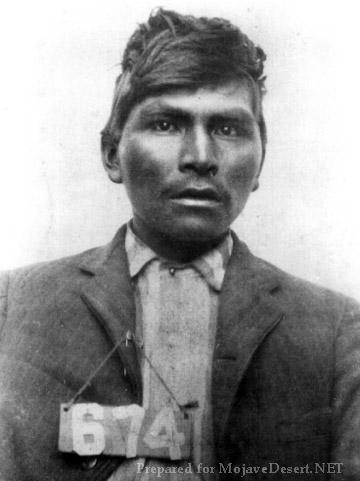
Willie Boy was a Chemehuevi man, part of the Southern Paiute people. He was born about 1882 in the Chemehuevi Valley and knew the desert country of Southern California and southern Nevada well. Like many Native people of his generation, he worked as a cowboy and ranch hand while remaining tied to his community and traditions.
Carlota was a Chemehuevi woman from the Oasis of Mara at Twentynine Palms. Her parents were William and Maria, Mike. William Mike, also known as Old Mike Boniface in many non-Native accounts, was an important Chemehuevi leader and spiritual man. Later, newspapers and popular accounts gave Carlota several names, including Isoleta, Lolita, and Mabel. The Chemehuevi family history identifies her as Carlota.
Willie Boy and Carlota were related. Under the Chemehuevi custom, their proposed marriage was not acceptable because they were too closely related. They had previously run away together but were found and separated by their families. Later, when the Mike family traveled to the Gilman Ranch near Banning for the fruit harvest, Willie Boy and Carlota met again.
On September 26, 1909, William Mike was shot and killed at the Gilman Ranch. The exact events leading to the shooting remain uncertain. Later accounts differ over whether Willie Boy went to ask Mike's permission to marry Carlota, whether a struggle occurred, and whether the shooting was deliberate or accidental. What is certain is that Willie Boy and Carlota left the ranch that night. Maria Mike reported the killing the next morning, and a posse soon began to follow them.
The familiar version of the story says that Willie Boy kidnapped Carlota and forced her into the desert. That conclusion came largely from statements by posse members and news reports published in the Los Angeles Times and Riverside Press-Enterprise in the weeks after the shooting, which repeated claims made by law enforcement without independent investigation. Chemehuevi family history, preserved through oral testimony and later recorded by tribal elders such as Josephine Mike and Clifford E. Trafzer (see Trafzer, Willie Boy and the Last Western Manhunt, 2020), tells it differently: Carlota went with Willie Boy, as she had done before. The record, including trial testimonies and interviews collected by historians Sandos and Burgess (The Hunt for Willie Boy, 1994), does not settle every detail of their departure, but it does not support repeating the kidnapping story as fact.
The chase moved from the Banning and Morongo country into the Mojave Desert. Posse members from Riverside and San Bernardino counties, joined by local volunteers and Native trackers, followed the pair for roughly two weeks. Among the trackers named in accounts of the chase were John Hyde and Segundo Chino.
Newspaper coverage quickly turned the pursuit into a public spectacle. Reporters described Willie Boy in racist and sensational terms, feeding fears that a local crime might become a wider uprising. The story gained extra attention because President William Howard Taft was visiting Riverside during the chase. Newspaper reporters turned this personal tragedy involving one Chemehuevi family into a national frontier drama. Sensational reporting not only influenced how the public viewed the events as they unfolded but also shaped later retellings of the story in books and films. The way the media covered the manhunt created lasting stereotypes about Native people and turned the tragedy into a mythic episode in the region's history, demonstrating the powerful role media can play in shaping historical memory.
Carlota was found dead near The Pipes, northwest of Yucca Valley. The posse said Willie Boy had shot her because she was slowing him down. People repeated that explanation for decades. Yet the Riverside County coroner found that she had been shot from a considerable distance. Later historians James Sandos and Larry Burgess concluded that the evidence made the posse's story highly doubtful and that Carlota was probably shot by one of the pursuers.
Chemehuevi oral history also holds that the posse killed Carlota. Some accounts say she wore Willie Boy's coat when she was shot, making a mistake in the confusion of the chase possible. Whatever happened in those final moments, her death became the point at which newspaper accounts turned Willie Boy from a man accused of killing William Mike into the stock figure of a savage outlaw.
Willie Boy continued alone. In early October, he encountered members of the posse near Ruby Mountain, west of present-day Landers. During the gunfight, Deputy Charles Reche was seriously wounded, and several posse horses were killed. The pursuers withdrew to take Reche for treatment. When the posse returned, they claimed Willie Boy had died by suicide and that they had burned his body.
Many later accounts accepted that ending, but questions remained. No clear, independently verified identification was made at the scene. Chemehuevi elders, including members of families connected with Willie Boy and Carlota, maintained that he escaped after the Ruby Mountain encounter. Their accounts say he crossed the desert and later lived among Southern Paiute people near Pahrump, Nevada, where he died.
For years, many people in the Chemehuevi community did not speak openly about the tragedy. Grief, trauma, and cultural rules concerning the names of the dead all helped preserve a quietness that allowed outside writers to shape the public story. In Chemehuevi tradition, speaking the name of someone who has died is often avoided in order to respect their memory and help their spirit move on. Families may keep their sorrow private and refrain from retelling events linked to the deceased, especially soon after a loss. These customs meant that important details of the history remained within the community and were not publicly discussed. When elders and family members later shared their memories with historians, they brought forward a history that had largely been missing from the printed record.
The Willie Boy story became legend almost immediately. A stage play appeared within days of the reported discovery of his body. Harry Lawton's 1960 book, Willie Boy: A Desert Manhunt, helped establish the popular version, and the 1969 film Tell Them Willie Boy Is Here carried it to a wider audience. Both helped fix the image of Willie Boy as a hunted outlaw. Later historical work has shown how strongly that image depended on sensational newspaper reporting and the untested claims of men who took part in the pursuit.
Recent artists and filmmakers have returned to the story from Native perspectives. In 2016, Cahuilla artist Lewis de Soto created Carlota, an installation at the Oasis of Mara in Twentynine Palms that draws attention back to the young woman who is often lost in earlier retellings. The Chemehuevi people helped make the 2022 film The Last Manhunt, which tells the story from a Native perspective.
No one may ever know the exact details of Willie Boy's final years. But the Chemehuevi account deserves to stand beside, rather than beneath, the posse's claim. It comes from the people whose families lived through the tragedy and carried its memory forward.
This is not only Willie Boy's story. It is also the story of Carlota, William Mike, their families, and a Native community living through a time of great outside pressure and change. The events highlight broader themes in California and Native American history, including struggles over land and sovereignty, the impact of settler colonialism, the way law enforcement and the press portrayed Native people, and how oral history challenges official narratives. The death of William Mike, Carlota's death during the chase, the role of the posse, and Willie Boy's final fate all require honest uncertainty in which the evidence remains incomplete. Examining this story helps us understand the larger complexities of history in the region and encourages a deeper look at whose voices are valued when history is written.
References
James A. Sandos and Larry E. Burgess, The Hunt for Willie Boy: Indian-Hating and Popular Culture. University of Oklahoma Press, 1994.Clifford E. Trafzer, Willie Boy and the Last Western Manhunt. Coyote Hill Press, 2020.
Clifford E. Trafzer, A Chemehuevi Song: The Resilience of a Southern Paiute Tribe. University of Washington Press, 2015.
"Willie Boy & Carlota - Notes," Digital Desert, 2025.
Julia Sizek, "Willie Boy: How a Manhunt Became Myth," Mojave Project, 2018.
University of California, Riverside, "Revisiting the Tragic Tale of Willie Boy and Carlota," 2021.
Dorothy Ramon Learning Center, "For You, Carlota."
Chemehuevi Indians
Twentynine Palms